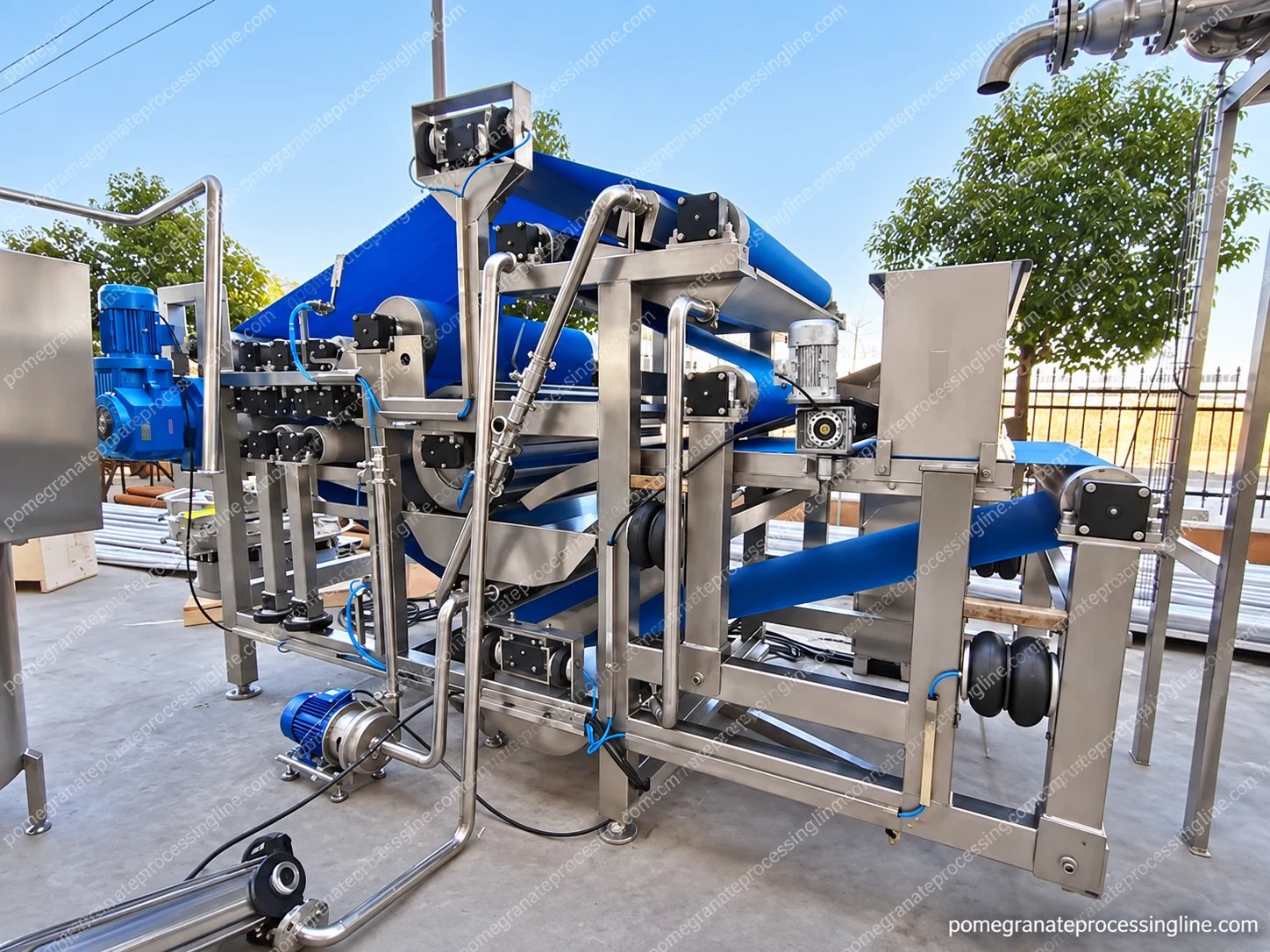
Follow material across the belt
Prepared arils are spread onto the moving belt rather than delivered in irregular piles. Juice drains from the material as it passes through the pressing path. Roller loading and belt travel act on the material bed, while the belt carries the remaining seed and solid residue towards discharge.
A steady upstream feed and a clear downstream liquid path make press behaviour easier to control. A flooded juice collection area can obscure the effect of a press adjustment, and intermittent feed can make a nominal hourly output misleading. The collection pump and tank-level control are therefore part of the extraction arrangement.
Measure the material and the product from the same run
Take representative feed, juice and residue samples over a defined interval. Record incoming aril condition, free liquid, carryover of peel or membrane, collected juice mass and the condition of the discharged solids. Check seed fragments and taste alongside colour and the chosen suspended-solids measurement.
Changes in pressure or feed preparation can change the composition of the extracted liquid. Increasing recovered mass is not sufficient if the result fails the product specification. Compare like-for-like lots and sample locations before attributing a change in astringency, sediment or colour to a single machine setting.
Start troubleshooting at the visible change
These observations narrow an investigation; they do not replace the machine’s operating and maintenance procedure. Guarded drives, rollers and belt tensioning components must be made safe before physical access.
| Observed condition | What to compare | Controlled response |
|---|---|---|
| Uneven bed or intermittent juice flow | Aril supply pulses, distribution across the belt and tank-level events | Stabilize feed and transfer before comparing pressing settings |
| Wet residue with falling collected output | Feed condition, belt drainage, fouling and residue discharge | Inspect the drainage and cleaning condition; compare a controlled feed trial |
| More seed fragments or a harsher taste | Incoming fragments, preparation carryover and changes to press loading | Separate preparation effects from pressing effects using matched samples |
| Juice pooling below the press | Collection outlet, transfer capacity and downstream high-level stops | Restore a clear designed transfer path; avoid masking the issue with higher feed |
| Belt tracking or tension changes | Accumulated solids, tracking components and drive condition | Stop and isolate before mechanical inspection or clearing trapped material |
| Rapid fouling after a fruit-lot change | Lot condition, suspended matter and cleaning response | Review the feed difference and cleaning effectiveness before raising throughput |
Keep extraction problems separate from clarification problems
A press-outlet sample establishes the extraction result before a clarifier or filter changes it. A second sample after separation shows the solids removal and product change attributable to that stage. Product held in a tank for too long or exposed to air during transfer can also change after it has left the press.
For a purchase trial, use the intended feed preparation and identify where every sample was taken. The resulting evidence supports the choice of press configuration, tank arrangement and clarification equipment much better than a peak extraction figure without a product result.